Monday, 23 May 2011

Chaos of Information

Hello readers,

I know its been a while since have posted anything on here. I have been, for the lack of a better term, preoccupied. If you didn't know, I am currently located on a different parallel than my last posts. But this is besides the point. Today's topic is Shannon entropy, based from information theory.

I have had the pleasure of reading Robert J. Sawyer's book, Wake. It is a great science fiction book. If you have chance to read it, do yourself a favour and do it! In the book they talk about this phenomenon and so I decided to look into further.

As some of you may know, entropy is the the measurement in chaos or disorder. This could be either from the arrangement of molecules or other areas in which can have disorder (there isn't a standard for the chaos on your desk). There can even be dis order observed in the tossing of a coin!

A fair coin has one side heads and one side tails. If we exclude the probability of the coin to land on it's side (neither heads or tails) then the probability of the coin landing on either side is 50%, that is, there is a 50% chance of heads and 50% chance of tails. This can be broken down to a binary system, a system of 1'sand 0's. In this example, the entropy is zero, since everything is fair, there is no disorder, everything is predictable. 

As we all know, our computers transmit data via the binary system, everything you see and hear are the results of many 1's and 0's. So, Claude Shannon (1916 - 2001) proposed a theory of communication. Entropy is used as a tool to predict the next event in a chain. For example, predicting the next letter in the alphabet in a word (think Wheel of fortune with half the letters already filled in). Entropy is set at 1 - 1.5 bits per letter. That is, there is some randomness, though English follows some rules, such as 'u' comes after 'q' on most occasions, or the letter is 'e' is the most popular letter. When we look at entire words the entropy increases between 10 and 11 bits per word. That is, the predictability of the next word is significantly less than predicting the next letter in a series of letters.

This plays into information theory well because we as humans are always looking for ways to maximize space. We seem to do well, what with our chat rooms. We have broken common phrases down quite a bit. We often say ttyl (talk to you later) or brb (be right back), thus sending smaller messages. But this theory says that you cannot compress all messages. Some messages must either stay the same or get bigger in order to convey it's meaning. For example, when I have to write an essay for a liberal art course, I start off with an outline of what I will want to write about. There is no way I can compress it due to word count qualifications. Thus, not all information can be compress and must be further expanded upon.

So that is Shannon Entropy. If you want to see the predictability for yourself, you just need to read a book. Before you turn the page, predict the next word. You'll be surprised how often you are right or wrong!

Thursday, 20 January 2011

Identity Crisis

*Note the writer does not fully believe in the topics of Astrology. This piece is just to clear up a few misconceptions of the news.*

If you haven't heard, last week something has happened. For all you horoscope followers, you already know. To everyone else this might shock you. The news is that your astrological Sun Sign could have changed! Scary isn't it? Are you going through an identity crisis? Don't worry, you don't have to.

Let's take a step back. You should be asking, why would my Sun Sign change? What has changed in order for my sign to change? The brief and simple answer is that there was another constellation which has prominence. But the answer is slightly more complex than you think.

As you all know the Earth has poles (Santa lives in the North Pole). There are 2 poles in actuality. There is the true magnetic north pole and the absolute positional north pole (inhabited by St. Nicholas). The magnetic North was determined to be in Ellesmere Island in 2005, progressing towards Russia 65 kilometres per year. Thus, it is still in Canada's great white north! Anyways, because of these poles, we can think of the Earth as a top, but slightly on an angle. This causes another circular motion that we do not usually think of for the Earth (besides it's daily rotation, and annual revolution around the Sun). This tilt cause our position relative to the Sun to change over the last 3000 years, when the original 12 Sun Signs were "read" in the sky. Since then another constellation, Ophiucus, has been spotted in the sky and was deemed important enough to become another Sun Sign.

So, does this change your horoscope? Not really. There are claims that this new Sun Sign will only "affect" those born in 2009 and onwards. Thus, if you are able to read this the same year of the posting, then you are the same sign as before.

Friday, 29 October 2010

Could We Be Holograms?

A recent postulate believes we are in a universe that is just a hologram. This is coming from physicist Craig Hogan.

Hogan has done his math and thinks he can prove that the universe is just one big hologram. It’s in the math, so is it true? Well, at Fermilab’s largest laser laboratory, we can figure out whether this is true or not. The measuring device is being dubbed “holometer.”

It has often been postulated that we lived in a weird universe. Ideas of how unsmooth space-time can get has been considered by many scientists such as Stephen Hawking.  Think of the universe as a digital camera. As you zoom in, it becomes increasingly pixelated. The same concept can be applied to our universe. There seemed to be “pixilation” in a German experiment that tried to measure gravitational waves.

So what is the design? It’s a lot like a classical inferometer, an apparatus that measures interference of light sources. This inferometer will be scaled a lot bigger than a classical one. The arms of the holometer are going to be 40 metres long, to increase the uncertainties of the apparatus. If the values still return to what the mathematics predict, then we are holographic!

Wednesday, 27 October 2010

Measuring Emotions

Hi folks,

It's been quite a while since I have posted on here. I have been terribly busy with work, SCHOOL and other duties that I have here in the big city (and other places). So let's have at it.

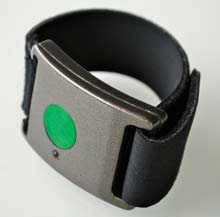
 Quite recently Affectiva, a group of MIT collaborators, has come out with an amazing little device. It is able to measure some emotional responses. It is called the Q Sensor. How can such a device be able to measure something subjective like emotional responses?

Well first off, it comes in wrist band form. Thus, it is constantly touching your skin. The skin has many mechanisms for many different types of emotional stressors. For example, when you are nervous, you start to secrete sweat. When one is excited or stressed, there is a slight electro-gradient that is created. This can be measured by the Q Sensor! It is the change in charges on your skin that the sensor picks up on. 

This device has many features, like being able to be hooked-up to a computer (via USB). There is a button on the device to mark times of significant events (like giving a presentation). 3-dimensional motion sensors to monitor how you move, and enough storage to keep logs for up to 4 months of events.

This is great for many Health Care professionals. Care givers can prevent stressors on their patients by monitoring the activities the Q Sensor picks up on. Preventing major stressors will help prevent some forms of cardiac arrest and other ailments. Once we know what stresses a person, we can help them calm down by doing other activities (meditation comes to mind). It can also help monitor sleeping patterns. The data can help understand when people with sleeping disorders are awakened and figure out how or why this event occurs.

This device will help with the understanding of some emotional responses. I believe these types of devices will help with  further explanations of ideas in consciousness.

Saturday, 7 August 2010

Elevator to Emptiness?

Hello dear reader. Today’s topic has been one that I have questioned a long time ago, and then forgot about it. Quite recently my housemate has shown me a cool internet tool called “Stumbleupon.” Even more recently, I stumbled upon a site that talked about the topic of Space Elevators.

So the goal for the space elevator is quite obvious. We are looking for an efficient method to travel back and forth, to and from the Moon (and other planetary bodies). The proposed method is using nano-carbon rods (these are quite strong and hard to break) to make a cable and then attach it to the moon. From this plain description, you may have found the problem. “Let’s attach this cable to an orbiting body!”

If we attach such a thing to an orbiting body, there will be adverse effects. When you attach two bodies, especially one that orbits the other, you are changing the orbiting pattern. Thinking about it, we would probably create something like a binary system. There is no real solution for that, except not to create such a device. Earth has more mass, thus, we would be swinging the moon around, which could probably knock it out of its original orbit.

As the moon is a key factor to the tide of our oceans, there could be some very adverse effects concerning our oceans. Fishing will become harder in some areas and easier in others. Sediments would be harder to for with heightened activity. Think of the “natural” disasters that would occur; Floods that seem to get stronger.
Depending on the placement of the cable attachment, we would be creating an artificial “North” and “South” pole. A new axis as to where it spins. This would change the speed in which the moon rotates. Moon gazers would notice that the dark side of the moon appears less often and the waxing and waning process is a lot slower, if not null.

We are going to find a different way to travel back and forth to parts of the solar system. We would be easily be destroying one of the only visually pleasing objects in the sky that people can see, even in light polluted areas (such as Toronto).

Wednesday, 21 July 2010

21st Century Lunatic

Hello Reader!

Today is a great day! It was beautiful out, the sky shined so bright. It was just an superb day.

Anyways, I have been given a challenge. Not quite me specifically, more of a broad thing. My brother posted on his wall "Write a letter to someone from the 19th century trying to explain an aspect of 21st century daily life. Guaranteed, you can't explain Facebook without making us all sound like lunatics." I am going to accept this challenge. 


Where to begin... I know! The fundamentals of Science. In this era, we had knowledge of (or on the way depending on the year) electricity, the battery, and electrical circuits. By the end of this century, we had a grasp of Alternating Current (Thank You Nikola Tesla). They were on the edge of everything big in the world of electricity and magnetism. Even in the last years of the century, Guglielmo Marconi created the first wireless communication device, the wireless telegraph.


So for those folks still stuck in the year 1897, here's what  Facebook is.


First we must introduce the computer. In a nutshell, a computer is an object that contain many electrical circuits that carry electrons (we know about electrons by now). These electrons carry numerical values of 1's and 0's. The 0's and 1's translate to information that can do math, which can determine output like colour, text, math equations and even sound. This is the basis of the computer. Many computers (or just one) can make something called a server.


In the 1960's the first unofficial model of the internet was used by the United States of America (Yes, the colonies survived and thrived!)  The internet is a network of computers, like that of neurons (you had the knowledge from Franz Nissl). Neuron are connected to send information back and forth from one neuron to the other. The internet uses the same concept. We are able to send information (via wireless electromagnetic waves or from electrons) from one computer to another. In recent years, the internet has been open to the public to use and abuse.


The internet runs on an IP address. An Internet Protocol address give the specific location of the computer/server. Sticking with the Neuron idea, it's like locating a specific neuron in the brain or anywhere in the nervous system. From there we have web pages.


A web page is like a brochure. Most of them are made with information that help you. Some websites are made to entertain. The difference is that a web page can be mutable. I mean it is able to have an interactive component, like playing a game. Word are able to be moved around. This brings us to Facebook.


Facebook is a web page in which people post what they like and what they don't. What is going on in their life and what they wish would. It's like writing a letter (in only a few words) to all your friends and they will understand whether you are happy, sad, angry or just plain crazy. You are able to talk with your friends from long distances (think wireless communication).


This is what Facebook is in a nutshell.

Friday, 16 April 2010

Problems with Time Travel (PT. 1)

I know I have broken my New Years promise, everyone does it though, so get over it. I know this is the first post in over a month and this one will be kept short, in order to study for my exams (I have one tomorrow -_-)

This topic has come from a quiz I was looking over to help study. Light was traveling faster than light. So I immediately thought about time travel because something that travels faster than light, is said to be able to travel in time.

So what happens if we build a machine that is capable of traveling in time but the actual machine doesn't move? I became quite curious and came up with this postulate. If the machine is stagnant and travels back in time, then it must exist at the same spot, at all times. That is, if it travels back in time to an era before the invention actual was constructed, then it must stay in that place for all time in between.

For example, this time machine is built in 2020 (this is highly unlikely) and I want to travel to my birth year. I will end up in the same place but on the date of my birthday. Where should this machine be built, because the past didn't have access to it? Also, think about this, if built in public, how would the population respond to you sitting in this machine traveling back in time? What if you got shot while on the machine right before the crowd disperses (or while just assembles by your point of view), when would it happen? Near your beginning of the travel or near the end?

As I said this is a short post and hopefully thought-provoking.

Sunday, 28 February 2010

Tinier Than Atomic?

What could be tinier than a Proton or a Neutron. Obviously electrons are smaller, but are there anything smaller or as small as the electrons? In the mid 20th century, the answer to this became quite clear. There were many "sub-subatomic" particles that interact with each other. These smaller than small particles are what makes up the Standard Model.

The standard models explains three of the 4 fundamental forces that occur in nature. The Weak Nuclear Force, the Strong Nuclear Force and the Electromagnetic Force. The force of gravity cannot currently be explained by the Standard Model. All matter has these interactions between them and are always subdued to each force (yes light is affected by gravity, hence light cannot escape a black hole).

There are three classifications in the Standard Model: the Lepton, the Quark and the Boson (currently sought after, the Higgs boson). These are the building blocks of the material world. For example a proton is made up of 2 up quarks and a down quark "glued" together by a gluon, which is a boson (or a force particle).

So what is an electron made of? Crazy enough, the little buggers are made of itself! They are their own type of particle. An electron is a Lepton.

The difference in Leptons and Quarks are the interactions that they participate in. Both are interactive and participants of the electromagnetic, gravitational and weak nuclear force. Leptons differ because they do not participate with the strong nuclear force.

So these are the building blocks of all matter, living or non-living. They are quite important in studying how things interact. Maybe one day we will learn how to build the strongest atom, piece together the lightest atom that can be harnessed... or build the most energetic atom and use it as fuel.

**Go Canada Go!**

Tuesday, 19 January 2010

Radiation From Within


Can you classify the Sun and a steel ball in the same category? What do you think? I think so. I know the Sun isn't metalic, but it is shiny... right? Right? Historically, this is the mother of Quantum Physics. The very beginning. Plank did well.

Anyways, the Sun and the steel ball can be categorized as... A Black Body! Do think of it the wrong way, think of black body as a scientific object. Let's dissect the word first, then we can check other fun properties.

Black: it's a shade in our "colour" scale that as my grade 8 art and grade 9 science teachers put it, "Absorb all light". White is different. It reflects all light. So if a perfectly black object absorbs all light, it is unable to reflect any light. Using this defintion of black, we can then define Black Body as an object that absorbs all light directed at it without emitting any light back (reflecting light).

The Sun can be considered a black body (Before I go any further, there is no such thing as a perfect black body in our known universe. There is only what we can approximate to be black bodies.). But you ask, why are we able to see white light emitted? This is what puzzled physicist Maxwell Plank. Not only that but with old models, we would have the Ultraviolet Catastrophe. So what changed?

Maxwell looked at the Sun (not for very long though) and thought that maybe what is being seen, was thermal energy. Energy, in the form of heat, was being converted to electromagnetic energy (light). So he figured out that the old models were wrong, and that his new formula and idea of light packets (or quanta) would help explain the empirical (experimental) data (as shown in the picture).

This new model indicated that at certain temperatures, there was a maximum intensity for a given wavelength. As the temperature increases, the maximum intensity of the wavelength increases. If you take the integration of this curve, you get infinity. The area under the curve is the energy per unit volume.

This was the problem with the old model. When you integrated the curve from 0 to infinity (wavelengths) it would say that you get infinite energy! Most of this energy was in the ultraviolet spectra. This was cause for concern! How could something forever be emitting UV radiation. This did not get picked up by health critics because they did not know of the adverse affects of UV radiation at the time.

So in all, a black body is something that emits thermal energy in the form of light and light like radiation. Oh and by the way... The steel ball, it is considered a black body at about 1000 K or 1273 degrees Celsius.

Sunday, 10 January 2010

Bell's Theorem

*For this post, you will need to read the "Spukhafte Fernwirkung" posted on July 10th, 2009 in order to understand this post more. I have read about the topic and find it somewhat complex. I will do my best to explain it.*

Before we get started, lets look at the EPR paradox or the Einstein-Podolsky-Rosen Paradox. In simple terms, there are 3 parts to the paradox. In terms of a system:

  1. Without disturbing it, if we can predict a physical value with certainty, then there exists a physical reality that goes with the quantity.
  2. Measurements of particle at place A cannot instantaneously disturb another particle at place B because nothing goes faster than the speed of light.
  3. Any complete theory in physics must be able to predict all elements of reality.

As shown in the previous posts, Entanglement has the ability of instantaneously transmitting information from one particle to another (for example electrons, whether one is spin up or spin down). Using the logic in the paradox, Einstein insisted that Quantum Theory (More specific, Entanglement) was an incomplete theory.

John S. Bell, a theoretical physicist came up with a theorem that coincides with the EPR Paradox. It states that "No physical theory can produce the all same predictions of quantum mechanics."

This is easier to understand if I set up a scenario. A pion is a subatomic particle which, when it decays, produces 2 photons that move in exactly opposite directions. They are entangled, since they were produced by the samepion. Now we want to measure multiple properties of the photons. Due to Heisenberg's Uncertainty Principle, we can only take one measurement of the photon accurately. So here is the conundrum, if we measure one propertie of photon 1, we automatically know with accuracy the same property about photon 2. Are we able to measure a property of photon 2 with great accuracy then? If photon 1 has a measured spin in the x-direction, we know the spin for photon 2 to be the opposite, in the same direction. But can we measure the y or z direction of the spin?

According to Heisenberg, we can only know one thing really, really well. So this would break down the Uncertainty Principle. Bell setup a assumptions for his inequality to work:
  1. Logic is valid
  2. There is a reality separate from its observations.
  3. Information cannot travel faster than light
There is an invalid argument because the we do know that information can travel faster than light (contrary to Einstein's belief). Scientists believe that the statement of "Logic is valid" could be wrong. We do not have the right mathematics to see if our statements are true.

Monday, 21 December 2009

Bored of Bohr?

Hey Reader,
What is that weird word ion the title: Bohr? Well, here we are talking about the physicist, Neils Bohr, the man responsible for the High School model of the atom! You know, that model that mimics the solar system. How did it come about? Why is it useful? Why is it used?

To start, lets see the history of the atom and the models. It started with Dalton, when he stated that the atom is the smallest unit of matter. He also stated that the atom is just a solid ball (such as a billiard ball). This formed the first theory of the atom
.

Then came J.J. Thompson, who realized that a charge can be induced onto the atom. Negative or positive, there has to be a way to charge an atom. He devised a model (sometimes called the plum-pudding model) in which allows the charges of the atom to be spread-out in a "solid" atom.

50 years later, a famous experiment, called the Gold Foil experiment was performed by Ernest Rutherford. His discover shocked the world of science. He shot positive particles (alpha particles) through a thin gold foil and placed detectors at different angles. He observed that many alpha particles was deflected at very small angles. they almost
passed right through!. How could this be unless there was a central nucleus with a positive charge. Thus, we learned that there was a central positive nucleus.

Borh showed that electrons are in orbits. Shown above, electrons circle the nucleus like planets around the sun. The first orbit holds 2 electrons, the 2nd and 3rd each have 8. This is NOT what the current model represents, but this is widely used in many people's education.

This model is useful because it explains a weird phenomenon
. Certain elements emit a certain spectra of light. To the right is a small spectrum (known as the Balmer) that is emitted from Hydrogen. Hydrogen emit other visible lights as well. How can this be explained unless electrons can get excited to different orbitals and de-excited states to lower orbitals. To produce light, with this model, an electron must go from a higher orbital to a lower orbital (Blamer series goes from any higher orbital to the 2nd orbital). This can be mathematically explained using the Rydberg-Balmer equation. The wavelength is correlated to the difference of squared orbitals.

Even though a more accurate model has been discovered, called Valence Shell Electron Pair Repulsion (VSEPR) theory, Borh's model is a very basic model that works well with the spectral phenomenon. We use it so we can better understand the light.

Saturday, 19 December 2009

Momenergy != Mom Energy

Hello Reader,

I know, it's been too long since an actual update to this blog, which is bad on my part As a New Years promise to myself (I make promises and not resolution for the simple fact that I don't have much of a problem needing to be resolved), I will try my hardest to have 2 updates/postings a month. Now this may get extremely difficult, considering my course load is quite heavy. But I am going to try to do it anyways.

Now, you probably read the title and wondered if the one word up there is actually a word. No I did not mean "Mom Energy", this is a scientific word. What I mean is it's a word that was created from scientist to use instead of using "Momentum-Energy" because saying that 10 times fast would be just too darn difficult.

What is Momenergy? Well, it's just that, Momentum AND Energy in the same 4-D vector. Like Space-time's 4-D vector ( [t,x,y,z] , where time is scalar value by itself), Energy and momentum make up a 4 dimensional vector [E, p_x, p_y, p_z]. It is a branch off of Einstein's Theory of Special Relativity. But unlike Spacetime, where you can have 2 different units (light seconds for space or seconds for time), there is only 1 designated unit for momenergy, and that is kilograms! Let's dissect this a bit:

Let's start with Energy. Most people measure it in Calories because that's what's on the food packages. But the standard units of energy are Joules. 1 Joule is 1Kg x 1m/s/s (unit of acceleration) x 1 meter or 1 Kg x 1 m^2/s^2. Now, recall that c (the constant, the speed of light) is pretty much the basis of Einstein's Theory, nothing can go fast than it (with 1 exception that I know of). So it would seem appropriate to use this in the calculation to figure out relativistic energy. Remember that c is a speed so the units are m/s so if we square it, we get m^2/s^2 and if we multiply by mass, we get mc^2, the world famous physics equation. But for relativistic purposes, we are going to have gamma (stretch factor) multiplied by mass. The stretch factor is in units of c. So that everything cancels nicely and we get only the units of mass left.
1/c * c * kg = kg

The same can be done for momentum because it's classical units are kg * m/v. But, here you will multiply together, the stretch factor, the mass and the relativistic speed. Everything still cancels out to kg!

These values when you use Lorentz geometry, will give you the rest mass of an object. These also play a role in the Uncertainty Principle. There are 2 forms to this principle, the momentum-space and the Energy-Time. It states that you cannot know both of these values simultaneously with extreme accuracy. So you either know Energy really well but not the time or you know Time with great accuracy and not the energy (this is on the atomic level).

Stay tuned for more stuff in the near future!

Friday, 9 October 2009

Spacetime is Kinky

*tiny post*
That's right, I said it. Dear Reader, Spacetime is Kinky. What I mean is the more kinks in your path, the less time it takes for you to reach your destination.

The reason for this is because we get out of Euclidean Geometry (what we are used to seeing) and go into Minowski Geometry. This is where we subtract values instead of adding. This only occurs with speeds comparable to light.

Wednesday, 16 September 2009

They Are Both Right?

Hello Reader,

So to continue with Einstein and his theory of Special Relativity, there are problem with classical physics that seem to be problematic. As we said last time, light is a constant. It onlychanges when it passes through different mediums. Keep this in mind.

Now picture a moving walkway. The wide, flat ecalator that moves in one direction (can be seen in airports). If you step on it and stand still while it moves, you are moving at the same speed as it is. but if you decide that you want to go faster, you walk, and the 2 speeds are added to give your new speed.

Classical Physics Failure #1

This is not true when you decide to shine a light while you are moving. When you shine a light while in a rocket moving at the speed of light (only hypothetical right now), then the light does not shoot ahead of you, but is matching your speed. You don't get to see any light.

Train Paradox

In this paradox we will show how 2 referance frames mystically can be right even though the conculsions are different.

Imagine a train with a passenger in the middle is moving at a constant velocity. There is another observer in the middle of a platform. As the train passes, lightening strikes both the front and tail of the train simultaneously. This occurs when the passenger and the platform observer (Joe for short) are lined up. They are both in the middle of the train.

The light reaches Joe at the same time, because he knew they were equal distances apart, he concludes that they happened at the same time.

Classical Physics Failure #2

Joe thinks that the train observer, Jane, will see the front flash first because of the speed of the train. And she does. But she has a totally different conclusion, the flash in the front occured first. If she sees it first, the event happened first.

Who is right?

Einstien said that if there are different frame of referances (perspectives) than there will never be agreement about simultaneousness of events. Therefore, both Jane and Joe are correct, in their own prospective.

This property is also involved with Length Contraction. This is the property where 2 measurments can be accurate because of the frame of referance. When I say measurements, I mean measuring anything in 1D, 2D or 3D space. NOT SPACETIME.

If you measure a desk, and you are at rest, you get an accurate measurement of the desk. Because both you and the desk are at rest. Now think of a small rocket that is able to take measurements. If it flew by with a high speed, would it get an accurate measurement? No! How could it? It can't just whip out a meter stick and measure.

Ahh.. But Time can measure distances, so is this accurate? Nope! The rocket actually is going to pass it faster than it can get an accurate measurement. The rocket will not get a proper length even though it will get a proper time for 2 event to occur.

Thursday, 10 September 2009

Time by Distance

Hello Reader,
So this week, so far, I've learned that I can measure time by distance and visa versa. Einstein's theory of Relativity is quite interesting.

Here is "practical" example I am going to use to explain what is actually going on. You are sitting in the back seat of a movie, there are 3 other people. 1 is enjoying the movie front row and center. and there is a couple off center but in the middle row. We all know that the dude in the front row will see the images first and you last.

We can figure out that you are 'x' meters away from the screen, but how many seconds away from the screen are you? How long does it take for the image propogate in your mind?

Another common example I can use is when someone asks you how far something is to travel, you usually give a time ex. "How far is the airport from here?" "It's about 45 minutes or so."

Well we all know that light is the fastest thing that travels. It's speed is 300,000,000 m/s in a vacuum (really close to air, we use the same value)! See the units? Meters per second. So to measure anything in a specific unit, all you have to do is cancel the other unit using c (the symbol for the speed of light). Either you multiply time by c or you divide meters.

So if you were 5 meters away from the screen, you are actually 16.6 nanoseconds away.

Thursday, 20 August 2009

Pitch Sickness

Hello Reader,
It has been awhile, but I have a post and that's what counts. Any guesses as to the topic? No takers? Well it's about a phenomenon that takes place in your brain (maybe). And it give us knowledge why we can't do what some celebrities can do. Guesses now?

Tone-deafness is quite troubling if you have a friend (such as myself) who likes to sing (even in public) and s/he doesn't know that they suck very badly at doing said task. Well a medical student at Harvard Medical School was studying music and the brain and realized that the brain of people who ARE tone-deaf have fewer fibres that go between the Temporal and Frontal Region.

One of the function of the Frontal Lobe is the ability to distiguish similarities and differences. In relation to the topic, the determination of the pitch of the actual song and the pitch your vocal cords produce. The Temporal Lobe is where the auditory systems get figured out. It's where we process what we hear.

So if we (yes, we... me included) have limited connections from these two brain regions, than we have issues determining the right pitch to... sing at.

*Post Blog*
So Reader, I will be travelling back to Toronto for Year Two of Medical Physics. I think my posts will be geared towards what I have learned, because one of my favorite Professors, Dr. Panar, taught me that to make sure you understand a concept, teach it. If you can teach it and it's understood, than you know what you are talking about. this will be a form of studying. so we shall see how it turns out.

Thursday, 30 July 2009

See and Be Seen


Hello Reader,

As a society that really wants to be seen, make a scene and individuals wanting to be noticed for something, we seem to be putting a bit of effort for the opposite! Ever wonder if not being seen is possible? Reader, I'm talking about invisibility. Using a device to hide oneself from other people's vision. Kind of like the Invisibility Cloak from Harry Potter.
*key idea: you need 2 main things for vision to occur. Object to be seen and an observer. Without either one, nothing can be seen*

For invisibility to work, the material being used must not be seen by the observer. As shown in the picture to the right, the material has to be able to reflect of the material, hit another above the object and bounce off the back. Unfortunately, this is very hard and maybe even impossible to do (have something follow you from above).

Let's take a step back for a second though. Light is an electromagnetic wave (we also know now, that it is a particle). That is, it changes from an electric field to a magnetic field very quickly. We know this thanks to James Maxwell. He also had thoughts about invisibility.

We know that most liquids and gases are "invisible" (transparent), but why is that? Atoms in higher excited states (due to heat, pressure or a bigger volume) have more spaces between them. This is a key role for such visibility problems. If the spaces between the atoms are greater than the wavelength of the light, then light is not given off. What about diamonds? Why can I see right through them? Some solids have special properties.they are called Lattices'. The atoms are arranged so that there are equal spaces between each other and is organised!

So how do we use such properties to become unseen? New materials are being worked on in laboratories called Metamaterial. These are materials that can bend light waves. So far, we are able to bend microwaves (smaller than infrared).

Light have a property called the index of refraction. If you have ever gone fishing and saw a fish in the water and decided to put a net over the fish, you know that you didn't catch it. this is because the index of refraction is responsible for the bending of light. This concept needs to be applied to an invisibility device. Metamaterial is special, in which it actually has a negative value for the index of refraction (everything you can see will always have a positive value).

This is quite close to the concept of Fibre Optics. In a fibre optic tube, light is bent at a 90 degree angle so nothing passes through it but stays contained in the tube. The US military has a device that uses fibre optics for an "invisible" cloaking device. this is the closest we are to such a cloaking device.

In Michio Kaku's book, Physics of the Impossible, he rates invisibility a class 1 impossibility. This means that it is not possible now, but will be in a matter of a decade.

Saturday, 18 July 2009

The Most Precious

I know this sounds pretty bland, but this topic, dear Reader, is about time. Think about it for a moment, really think about it. As your reading this, subconsciously, you're either hoping this doesn't take long or this takes as long as you can imagine. Today's post will explaining how we have depended on time, how it's viewed in science and different views on time.

Time seems to be everything. We get paid per time, our life relies on every minute, every hour and even years. We celebrate an annual event that occurs when we are either conceived or born. For those married, you have an anniversary - returning every year - a yearly celebration of your marriage. But it seems much more important than this.

As Our Lady Peace said in R.K. On Death, "[Death] gives importance and value to time.
Time would become meaningless if there were too much of it." I find this to be absolutely true. If we never concieved an idea to measure amounts of different periods, we would never care about what we do as humans.

I'm sure you have heard of this: Space-time. Do you really understand it's meaning? Well, space-time is what are known as dimentions. You see in 3-D, three dimensions. You can see up and down, left and right, and because you have 2 eyes that are far enough apart, you can see depths. Well, time has been added to the well known dimensions, for scientific pruposes to understand things at the quantum level and on a grander scale alike. Einstien used it for his Theory of Reltivity. Using a 4th dimension helps to illustrate what would happen to us if the sun just vanished out of thin air (we would still move around the Sun's orbit until we about 8 minutes [speed of light from Earth to the Sun]. Then we would float away).

The reason why I have posted this topic is because a pseudo-suggeustion from a friend made me curious about a website, timecube, which should be bashed, in my opinion. But main concept is a bit weird, he claims we live on a 4 cornered planet in which we experince 4 days instead of 1. this is interesting because we have thought for the longest time, until explorers from Asia and Europe travelled to the Americas. We even have travelled to space and have taken many images of our own planet. The result: We are still spherical. He bashes the education system, because it teaches the 24-hour system. Needless to say, Time Cube is not a likely thing to be taught in any school in the near future. We have made a system that works out mathematically and seems suffcient enough.

I also recently completed a book by Canadian author, Robert J. Sawyer. The main plot revolves around a neanderthal being quantumly transported to our part of the multiverse universe. They have a metric time system. That is to say, a day is 10 hours long. Metric time probably could work, if we thought it out properly, but very unlikely to work. We already use the metric system for time, before a full second aka milliseconds and after a full year aka decade, century, millenium ect.

How could metric time work? Well, let's do a few calculations:
We have 60 seconds in a minute, 60 minutes in an hour, 24 hours in a day, 365.25 days in a year (every 4 years is a leap year). So we will multiply each value.
60 * 60 * 24 * 365.25 = 31557600
Because we don't have that many zeros ending this number, this is difficult to do. We just would have the same amount of daylight in a day as we do now.

Hope you enjoyed, and wasn't a waste of time. Sugguestions for new topics and comments are always welcome.

Sunday, 12 July 2009

Life Away From Earth??

Hello Reader,

do you think there really is life out there? Did Roswell actually happen? Or are you on the other end of the spectrum, no life other than terrestrial being? Well today we will explore the mathematics of extra-terrestrials!


That’s right, math that predicts the probability of other aliens.


The equation is called the Drake Equation. This equation was brought about by Dr. Frank Drake of University of California who is a scientist in Astronomy and Astrophysics.


Not only does the equation predict how many civilizations are out there, it also predicts advanced civilizations! How many are at our level of intelligence and beyond. Without further ado, here is the ever so famous equation:


N = R x P x Ne x L x I x FC x LT


What do all these wonderful letters mean?


  • N is the number of aliens that possible could contact us or visa versa.
  • R is the average star formation
  • P is the fraction of stars that have planets surrounding it
  • Ne is the number of planets that could support life for every star that has a planet
  • L is the fraction of planets that WILL have life on it... at one point. Because everything started off as a single celled organism, this is going to be higher than N
  • I is the fraction of l that will become intelligent life. This could be an animal (anything that has a structure like our neural system).
  • FC is the fraction of intelligent life that can and will build a detection device for communication purposes.
  • LT is the time length in which a signal will be sent.


Here are values that have been used with this equation (taken from Wikipedia):


  • R = 10/year the Milky Way averages 10 stars per years.
  • P = 0.5 about half these stars will develop/pull planets into its orbit.
  • NE = 2 scientists believe that 2 of these planets will be able to support life.
  • Recap so far: 10 stars, 5 stars with planets 2 of these will have planets that support life.
  • L = 1 (100% of these planets will develop life of any kind. Such as microbes or amoebas.) (I would think only 50% at most but let’s go with this)
  • I = 0.01 (1% that could be intelligent)
  • FC = 0.01 (1% that could communicate with us.)
  • LT = 10,000 years (how long the civilization will last 10,000 years)


If we multiply each of these numbers together, we get N = 10 alien beings that we COULD encounter. This is only theoretical and we still have yet to encounter any (except possibly at Roswell).


If we use my 50% instead of the 100% for the ‘L’ value we come up with 5. This seems more reasonable. Makes sense why we have yet to encounter anything in this vast galaxy.


That concludes Drake’s equation. As always, comments are always excepted and topic suggestions are welcome as well.


Thanks for reading Keith’s Mind.

Friday, 10 July 2009

Spukhafte Fernwirkung

Hello Readers,

If you tried reading those words and succeeded, you can speak German pretty well. These words were spoken by a very famous person, about the topic I am about to deliver!

Einstein thought entanglement was a "spooky action from a distance". This is also the idea that he played with until his passing. He thought it was so impossible that if he didn't find the truth of the matter, he would change professions.

At the basics, entanglement is very simple. 2 subatomic particles can "share information". Here's where Einstein got angry. The mathematics show that at any distance, the "information" is sent instantaneously. That is, faster than the speed of light (that was precisely when Einstein stopped making hair appointments).

Remember that I said "electrons are weird little buggers"? Well, there are smaller subatomic particles. Let's say, sub-subatomic particles. These wee things that make up the other wee things (smaller building blocks for the neutrons, protons and electrons). These are leptons, quarks and bosons. Bosons are the force particles aka the particles that help hold atoms together. Quarks are the fundamental masses of the subatomic particle. Leptons are what gives a subatomic particle its spin.

It's weird to think about but all subatomic particles have a spin to it. Scientists have actually given it a numerical value of 1/2 or -1/2 (up or down). The spin of the particle is what information is sent. (A bit of romance ahead) Each subatomic particle has a counter part somewhere in the universe. They are "related" to each other. If an electron has spin up, then its counterpart has a spin down value to it.

That doesn't sound to weird, so why did Einstein freak out? Say these particles were separated to either side of the universe, what do we have? We have one spin up lepton on the far left (for visual purposes) and one spin down to the far right. If the spin changes (which it can) than the other changes to oppose it, instantly.

This concept has helped the idea of quantum teleportation. Scary to think that we could travel faster than the speed of light. But in order for us to travel quickly, we need to build a "holding" bin to put the opposite spinned subatomic particles in.

I hope you have enjoyed my 3 part series on Quantum Mechanics. Any and all comments and questions are welcome. As always if you have an idea for this blog, don't be afraid to tell me, via comments as well.

Happy reading!